



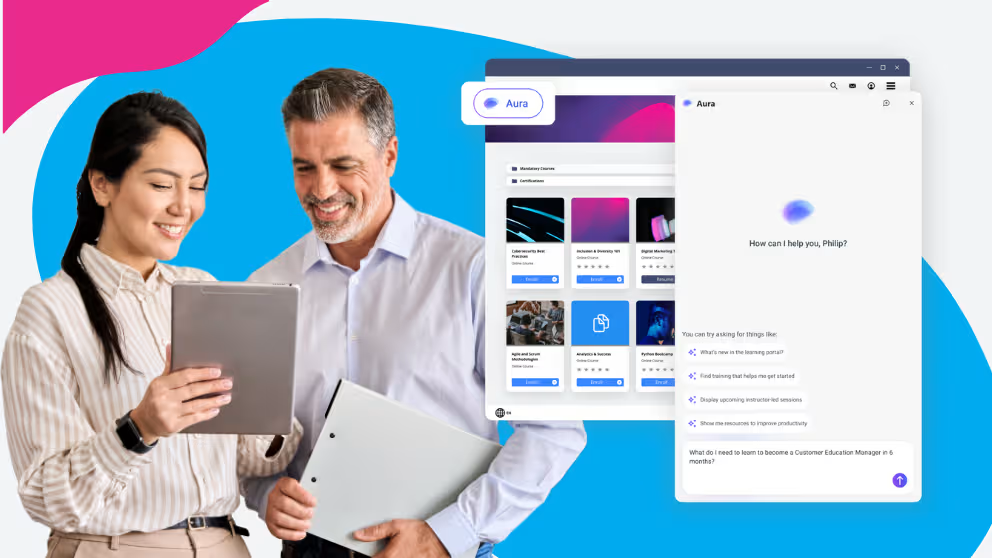

Most L&D teams can show who completed a course, but far fewer can show whether that course changed anything: whether it shortened onboarding, accelerated deals, or reduced support escalations, or whether the business is actually more ready after the training than before it.
Finance and operations have been asking that question for years, and it’s the question that makes learning budgets feel hard to defend. Absorb Aura is designed to close that gap. By connecting learning activity to operational data and performance signals, it helps organizations connect learning to business outcomes in a way that’s credible, secure, and useful to the stakeholders who need to understand it.
This article explains the problem, the mechanism, and what it actually looks like in practice.
The outcome gap: Why legacy learning metrics fail
Completions are a record that someone showed up, and the business knows the difference.
The LMS was built to manage courses and track who completed them, and completion data has real value in the right context. Over time, though, the field tried to attribute far more to it than it could actually support, stretching a useful administrative record into a proxy for business readiness it was never designed to provide.
A completion report can show that a sales team finished enablement training, but it cannot show whether deal progression improved, whether new reps are saying the right things in front of customers, or whether a support team is resolving tickets faster because of what they learned. Those answers live in CRM data, HRIS records, and support ticket volumes. Most learning programs were never built with that connection in mind.
The success metrics should have been defined at the start: what does readiness actually look like, and how will anyone know when performance shifts? Instead, many teams are now trying to prove value in reverse, after the program already exists and the budget conversation has already started.
Connecting learning to business outcomes means showing how training relates to measurable work performance, not just course participation. Relevant outcomes include revenue performance, sales readiness, support productivity, onboarding ramp time, compliance execution, and operational efficiency.
Learning metric | What it shows | What it does not prove |
Course completion rate | Who finished training | Whether performance changed |
Quiz scores | Knowledge at a point in time | Skill application on the job |
Time in platform | Engagement volume | Whether content was relevant or effective |
Enrollment numbers | Program reach | Business readiness |
The data that answers the real questions has never lived in the LMS, which is exactly the gap Aura is built to close.
Securely bridging data and agentic action
The closed loop starts here: operational signal to identified gap to targeted learning to measurable shift.
Aura connects learning activity to operational data
Every organization already has the data that tells the performance story, and it lives in Salesforce, ServiceNow, Workday, HRIS platforms, Microsoft Teams, and the other systems where work actually happens. Connecting it to learning activity has always required specialized skills and access that most learning teams don’t have on their own: data engineers, BI tools, and a multi-step process through systems like Snowflake that creates enough friction that most teams never actually complete it.
Aura changes this equation. Rather than asking L&D teams to manually correlate LMS records with business system exports, Aura creates that connection inside the learning system itself, with no separate process and no dependency on another team’s data access. When those correlations happen, the pattern is consistent: people engaged with relevant, targeted learning perform better. The challenge has always been making that connection visible and fast enough to be useful.
Model Context Protocol supports secure, in-place context
Aura uses Model Context Protocol (MCP) to access relevant operational context securely and in place. In plain terms, MCP allows Aura to read the signals it needs from connected systems without duplicating or moving sensitive data into a third-party environment. Your data stays where it lives, and Aura reads only what it needs to inform learning decisions.
This architecture matters for CISOs and IT leaders who need assurance that an AI-powered learning system isn’t creating new data risk while solving a measurement problem. It also makes it possible to bring data together across sources without giving any individual user direct access to data they probably shouldn’t have, while still making the correlations that prove learning’s impact visible inside the learning system.
Coordinated agents turn insight into action
Aura’s real differentiation from a passive analytics layer is what happens after it reads a performance signal. Most AI tools in learning can suggest a next step. Aura assigns it, enforces it, and ties the action back to the numbers the business already tracks.
Aura is an agentic learning system, specifically a coordinated suite of AI agents that share context and work together. The Learner Agent creates personalized learning paths aligned to role, history, and identified gaps. The Discovery Agent surfaces the right content through semantic search. Admin Assist provides in-platform guidance that resolves routine questions before they become support tickets.
Together, they create a closed-loop learning system that measures operational outcomes, identifies skill gaps, recommends targeted learning, supports application in the flow of work, and then measures whether performance shifts. Over time, what worked for one sales rep struggling to sell into a specific vertical becomes the starting point for the next fifty who face the same challenge, because the system is learning alongside them.
Flow-of-work delivery: Practical scenarios in action
Learning reaches people inside the tools where work is already happening.
Why flow-of-work delivery matters
Asking employees to leave their work tools to access training creates friction, and every context switch is an opportunity for the learning moment to not happen at all. Aura reaches employees through Microsoft Teams and the Aura Chrome Extension, putting guidance inside the environments where work is already underway, with no separate login and no course catalog to navigate.
The goal is precision: the right learning, in the right moment, before the gap costs something.
Sales enablement
Aura monitors CRM activity signals and can identify when deal progression slows in ways that suggest a readiness gap. When a rep’s pipeline stalls at a specific stage, Aura can surface targeted negotiation or product knowledge support directly through Teams, in the moment the rep needs it rather than weeks later in a scheduled course. With readiness gates in place, no one gets booked on a high-stakes call before they’ve actually met the bar.
Customer support training
Support teams face constant pressure to resolve issues faster with accurate information. Aura supports reps with answers grounded in approved LMS content and organizational knowledge rather than unverified sources. At the administrative level, Admin Assist deflects 40–60% of routine training support tickets by resolving how-to questions instantly and in real time, with a 95% useful response rate and 94% of questions resolved in a single reply. In beta, every one of those interactions was enterprise-compliant, grounded in customer-approved content with no exceptions.
Employee onboarding
Aura’s Discovery Agent creates personalized onboarding paths from day one, aligned to role expectations and operational targets from HRIS and workflow systems. The Q&A Agent provides always-on support for new hire questions without waiting for a trainer or manager to respond. For organizations hiring at scale, this compresses the ramp timeline without requiring a proportional increase in trainer capacity.
This is where most organizations shift from measuring training activity to measuring performance impact.
Traditional LMS vs. AI Copilots vs. Absorb Aura
Different tools are solving different problems, and the category distinction matters.
The market conversation has evolved from “does your AI answer questions” to “can it take action,” and the shift matters because providing an answer doesn’t necessarily close the gap that created the question. Getting to the root cause of why someone needed that answer in the first place is a different capability altogether.
Platform | Primary role | Why it matters |
Traditional LMS | Tracks completions | Essential for administration and compliance, but limited to activity reporting |
AI copilots | Answer questions | Useful for fast support, but typically lack a full learning-performance loop |
Absorb Aura | Connects learning to outcomes and acts on them | Links learning activity to operational outcomes, identifies gaps, and supports targeted action through a coordinated agentic system |
Most organizations are missing the link between what people learned and what changed as a result. A system that identifies a capability gap and triggers a targeted learning action without anyone manually bridging between systems is a fundamentally different kind of infrastructure than either a completion tracker or a question-answering layer.
Learning impact needs a system, not another activity report
Capability visibility only creates value when it reliably changes decisions.
The organizations that get the most from learning have stopped treating it as a department that creates content and started treating it as the infrastructure for how they operate, making sure teams are prepared for the moments that move the business forward. That shift produces a competitive advantage that’s hard to put your finger on from the outside, but it’s visible in ramp times, retention, compliance readiness, and revenue performance.
Absorb Aura is built to support that shift by linking training activity to operational data, helping teams identify gaps and act on them, and letting the business translate performance changes into financial value using their own metrics and finance models. Aura connects learning to business outcomes, and the dollar conversion belongs to the business.