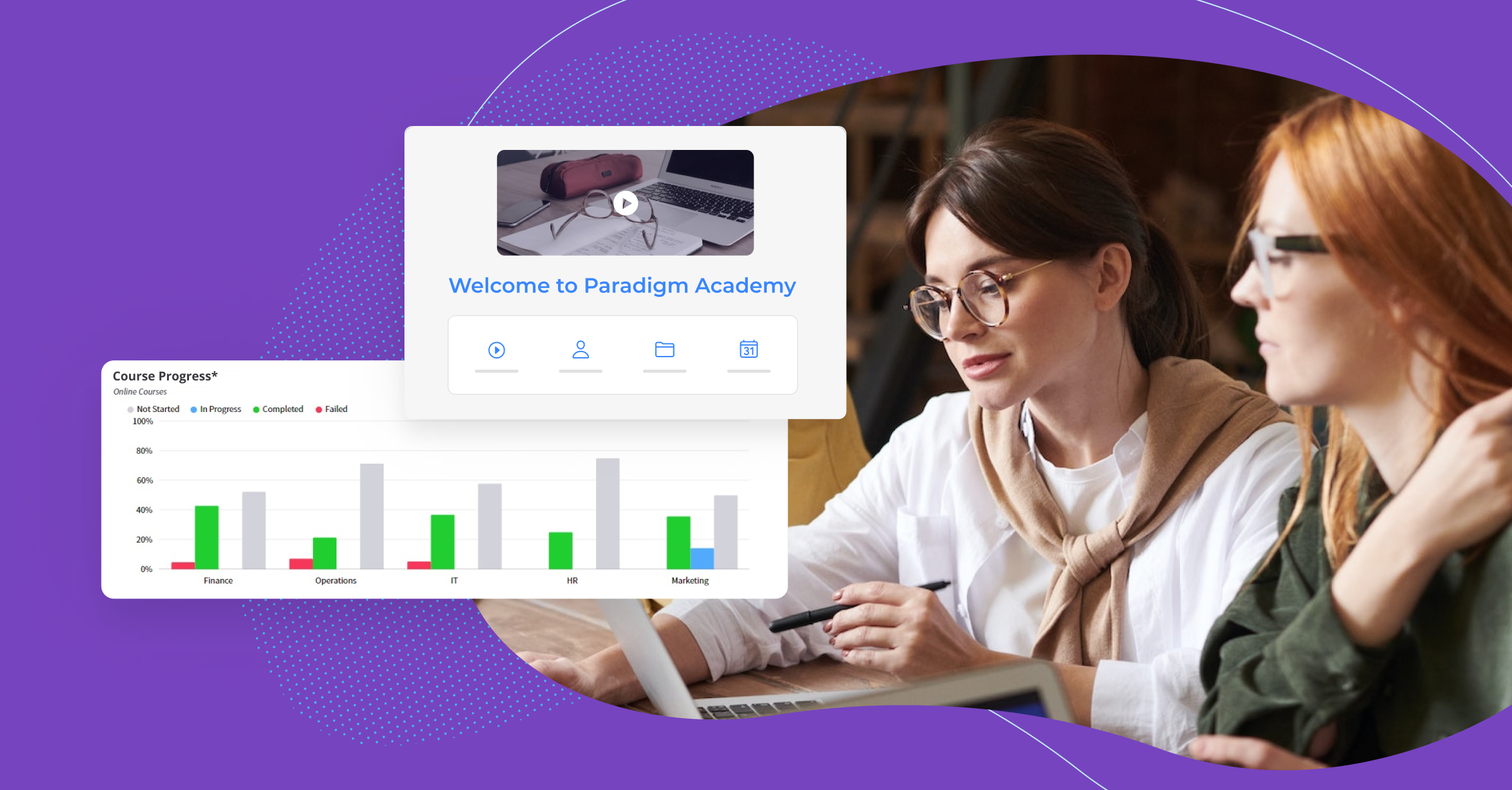
Your enterprise learning management system (LMS) should be flexible or scalable without a fight. If you find yourself frustrated, it’s time to trade duct tape for a powerful, modern system that’s built for return on investment (ROI) success.
Every day, learning and development leaders, partner‑enablement managers, and customer‑success directors ask the same questions:
- We’ve nailed employee training… so why are customers still confused?
- Why are partners misaligned?
- Why does every franchise location interpret our standards differently?
The real opportunity lives beyond the employee base.
Enter the extended-enterprise LMS, the system built for the audiences who often drive the biggest impact but receive the least structured support: customers, partners, resellers, franchisees, suppliers, and members.
This guide shows you exactly how to unlock that opportunity.
What’s an extended-enterprise LMS?
An extended‑enterprise LMS is a learning platform that has all the core functionality of a traditional internal LMS but it’s also built to educate audiences outside your employee base—customers, partners, resellers, franchisees, suppliers, and members—through multi‑portal branding, certifications, analytics, and e‑commerce, all managed centrally. It’s purpose‑built for adoption, enablement, and revenue, not just internal training and learning.
Traditional LMS vs. Extended-enterprise LMS
Extended‑enterprise LMS use cases span customer education, partner enablement, franchise operations, supplier compliance, and association learning. These have distinct requirements that internal LMS platforms can’t support.
Traditional LMS | Extended-enterprise LMS |
|---|---|
One audience: employees | Multiple audiences: employees, customers, partners, suppliers, franchisees, members |
Compliance-first | Adoption, enablement, revenue-first |
One brand experience | Multiple branded portals |
Internal use only | Global, external learning at scale |
Why extend learning beyond employees?
“But we already train employees. Why do we need something else?”
What if you’ve nailed employee training, but your support queue is bonkers, partners are out of sync, and franchises “interpret” standards?
If you’re using an internal LMS for external audiences, you're driving a mini van in a Formula One race. To compete and get a meaningful ROI, you need multi‑audience portals, on‑brand experiences, analytics, and e‑commerce—on purpose.
Ask yourself if you’re using an internal LMS for an external job. If you need your LMS to do some heavy lifting outside your internal employee training, a modern enterprise LMS can get you multi‑audience portals, on‑brand UX, analytics, and e‑commerce.
How extended enterprise learning drives measurable business outcomes
1. Reduces training and support costs
Great external learning educates and gets busywork out of your face. An extended‑enterprise LMS gives customers, partners, suppliers, and franchisees an always‑open learning lane, so your team stops playing Groundhog Day with the same demos and ticket replies.
The concrete payoff? Lower cost‑to‑serve, lighter support queues, and far fewer “got a minute?” emergencies.
2. Accelerates onboarding, launches, and partner readiness
Speed is the whole game. Give every external audience a clear path, a certification to hit, and role‑specific wayfinding. Activation can move from slog to sprint!
Customers ramp faster. Partners start selling sooner. Franchisees stop freelancing your brand.
The concrete payoff: Shorter onboarding cycles, cleaner launches, and partner programs that scale without babysitting.
3. Increases revenue through education and enablement
When educated users succeed, they can spend. An extended‑enterprise LMS can increase income from paid academies, premium certs, and training subscriptions.
When partners really understand the value they’re selling, they can stop pitching the bargain bin and start landing bigger deals.
The concrete payoff: Higher adoption, stronger channels, and new revenue streams—all powered by the same learning engine.
See our customer education webinar here.
Who uses an extended‑enterprise LMS?
Extended‑enterprise learning is the quiet growth engine behind the teams that touch revenue, retention, compliance, and customer experience. Here’s who relies on it, and why.
1. Customer education and onboarding teams
When customers can learn without opening a ticket, it means less time-bleeding and more compounding value for your business. Self‑serve education means tickets drop, adoption climbs, and operating costs shrink because your team isn’t answering the same five questions on repeat.
E‑learning also sticks. Research shows retention improves by 25–60% when learners can revisit content anytime—something no support queue or one‑off webinar can compete with.
The right LMS can become a scalable engine for customer onboarding, including activation, satisfaction, and product mastery.
Train customers, partners, and external stakeholders at scale
Create the content once, deliver it infinitely. Your academy becomes the always‑available expert—no scheduling, no capacity limits, no “Please can you resend that?” chaos.
2. Partner, reseller and channel enablement teams — turn learning into a revenue driver
The market is already calling it: the external training category has grown 3.45% year‑over‑year since 2022, putting extended‑enterprise learning among the fastest‑rising L&D priorities.
Partners sell more when they’re trained well. Resellers stay aligned when certifications aren’t optional. Channels perform when you replace scattered PDFs with structured learning paths.
Paid academies, subscription‑based training, and credentials transform learning from a support expense into a high‑margin product. And you can still keep your core onboarding free and frictionless.
3. Franchise, supplier and compliance‑led organizations — reduce support load and improve product adoption
For industries with complexity baked in—SaaS, franchises, regulated operations, safety‑driven environments—extended‑enterprise learning delivers outsized ROI.
Why? Because every repeated explanation, every manual training reminder, every inconsistent standard operating procedure (SOP) costs money. When you centralize learning in purpose‑built portals:
- Standards finally stay consistent.
- Compliance stops being a spreadsheet chase.
- Product adoption accelerates because everyone learns the same way, at the same pace, with the same expectations.
Create once. Deliver infinitely. Scale without hiring an army.
It’s operational smarts—powered by structured, branded, data‑rich learning. Once you know who you’re supporting, the next step is to understanding what the platform must deliver so every audience gets the right experience without multiplying your workload.
What your extended-enterprise LMS should do for you today
1. Deliver purpose‑built, branded experiences for every audience.
Your LMS should support dedicated, fully branded portals for customers, partners, franchisees, suppliers, and members — not force everyone through a repurposed employee login. External users should feel like they’re entering their space, not HR’s.
Multi-portal experiences let you segment customers, partners, franchises, and suppliers without leading sensitive info, or creating admin chaos.
2. Turn enablement into a structured, measurable learning journey.
Expect your LMS to go far beyond file storage. It should support learning pathways, milestones, badges, and certifications that guide users toward mastery and let you prove competency across every external segment.
Structured learning journeys shorten time-to-value and reduce support volume. This also means faster onboarding and reduced operational risk.
3. Give you cross‑audience analytics that tell stories that mean something.
A modern LMS should let you instantly see adoption, progress, performance, friction, and outcomes — broken down by customer tier, partner type, region, franchise location, or membership cohort. No analytics? No control.
Cross audience analytics, help you spot friction, prevent churn, and tie learning behavior to goals.
4. Monetize your expertise without duct‑taping plugins together.
Your LMS should make it easy to launch paid academies, subscription programs, certification bundles, and gated learning paths — all with built‑in e‑commerce tools (payments, promo codes, bundles, gateways).
Native eCommerce turns training into a revenue engine! Package, price, and scale education programs without adding manual opps overhead.
5. Automate the repetitive stuff so your team doesn’t have to.
Expect automated enrollments, reminders, expirations, role‑based nudges, and compliance tracking that run quietly in the background.
Automation slashes repetitive admin work. The system should handle the ops overhead so your team can focus on strategy instead of chasing people.
Playbooks: Scenarios + extended-enterprise LMS checklists
These are common extended-enterprise LMS use cases. Every audience in this table touches revenue, risk, or retention. But most are still handed an internal LMS and told to “make it work.”
Who + what they want | What usually breaks | What an extended-enterprise LMS unlocks |
|---|---|---|
Customer success teams: Want faster onboarding and reduced support load | Content scattered across tools; too many tickets | Self‑guided learning; brand‑controlled experiences; fewer escalations |
Partner enablement: Wants confident, high‑performing partners | Inconsistent materials; lack of certification tracking | Standardized training; global partner readiness |
Resellers: Want better product knowledge → more sales | No unified training hub | Segmented portals; customer relationship manager (CRM)-integrated learning paths |
Franchise operations: Want consistent standards across locations | Manual delivery; compliance gaps | Automated reminders; audit‑ready reporting |
Suppliers: Want to meet safety/regulatory standards | Hard to track progress across vendors | Centralized compliance training |
Associations Engaged members; monetizable education | Outdated formats; poor UX | Branded learning experiences; paid credentialing |
But when you start working with an enterprise extended LMS, the solutions to those goals are easy to initiate and high-impact.
1. Customer education and onboarding
Goal: Faster time‑to‑value, fewer tickets.
- Launch a customer‑only portal with brand‑true UX.
- Convert the top 10 ticket themes into 5‑minute modules.
- Role‑based paths (Admin, Power User, End User).
- Gate advanced features behind certification.
Track: Activation time, task completion, deflection rate.
2. Partner and reseller enablement
Goal: Pipeline quality, win rates, attach.
- Partner portal segmented by tier/geo/solution.
- Require credentialing before co‑selling.
- Sync LMS→CRM to expose partner readiness to reps.
Track: Certified partners, opps influenced by certified partners, average selling price (ASP) lift.
3. Franchise and multi‑location ops
Goal: Consistency, compliance, customer experience.
- Lock mandatory modules by role/location, auto‑remind, and audit‑log everything.
- Standardize operational procedures as video + checks (no more padlocked knowledge).
Track: Time to operational readiness, compliance pass rate, customer Net Promotor Score (NPS) by location.
4. Suppliers and external contractors
Goal: Safety, regulatory adherence, lower risk.
- Centralize training with vendor‑specific portals and completion tracking.
- Require re‑certification windows and block access on expiration.
Track: Incident rate, time to corrective action, audit readiness score.
5. Associations and member organizations
Goal: Engagement, renewals, education revenue.
- Package pathways into paid courses and subscription bundles.
- Offer tiered credentials members can market (badges/certificates).
Track: Course revenue, renewal rate, course completion velocity.
These playbooks show the pressure points. The challenge now is making sure your LMS platform can handle everything seamlessly.
How do I know if I need an extended-enterprise LMS?
Check your organization for these six signals that you’re overdue for an extended‑enterprise LMS.
- Support déjà vu: The same five questions flood tickets every week. Self‑serve education doesn’t exist, so humans carry the load.
- Partner drift: Enablement “lives” in PDFs, email threads, and a bandwidth‑starved portal nobody trusts. No certification, inconsistent outcomes.
- Franchise free‑for‑all: Every location interprets standards differently. You chase reminders and audits you can’t automate.
- Onboarding lag: Customers and resellers take too long to activate because you “teach” in docs, not structured paths.
- Missed revenue: Buyers keep asking for deeper training. You keep giving it away.
- Brand breakage: External users feel like they’ve entered a back door to an employee tool. It’s off‑brand, confusing, and optional.
Choosing the right extended-enterprise LMS for your organization
Selecting an extended‑enterprise LMS isn’t a feature list/check-the-boxes moment. It’s choosing the central nervous system for every learning experience beyond your employee base.
The right platform should handle complexity without making your team train like Cirque du Soleil performers, scale cleanly across external audiences, and give you the power to deliver branded, revenue‑impacting learning at all the touchpoints that matter.
This is where most LMS platforms tap out. And where a true extended‑enterprise learning management system proves its worth.
1. Audience segmentation and multi‑portal experiences
An extended‑enterprise LMS should let you deliver many branded portals from one engine, giving each audience — customers, partners, franchisees, suppliers, members, and internal teams — its own tailored experience. This is the core differentiator from a traditional LMS, which can only support a single internal audience.
Multi‑portal design ensures every segment gets the right content, the right navigation, and the right permissions without creating administrative chaos.
This enables:
- Distinct customer and partner academies
- Franchise‑specific training environments
- Supplier compliance hubs
- Member education experiences
- All centrally administered but individually branded
2. Flexible monetization and eCommerce capabilities
If you plan to generate revenue through learning (now or later), your LMS must include built‑in eCommerce, not bolt‑ons.
Look for features like:
- Subscriptions
- Bundles
- Promo codes
- Payment gateways
- Sellable certifications
This lets you transform training from a support overhead into a high‑margin product, especially for associations, professional certifications, and advanced customer or partner education.
3. Reporting and analytics across external learners
A modern extended‑enterprise LMS should give you analytics that go beyond employee reporting. You should be able to see adoption, progress, behavioral trends, and business impact across every audience — by role, tier, region, customer account, partner type, franchise location, or supplier category.
What this unlocks:
- Identify accounts at risk due to low product adoption
- Track partner readiness and its correlation to pipeline
- See which franchisees lag on compliance
- Spot high‑value learners for upsell or expansion
If you can’t see it, you can’t scale it — and you can’t prove ROI.
4. Scalability, security, and global accessibility
External learning introduces far more complexity than internal LMS use — from permissions to traffic to global delivery.
Your extended‑enterprise LMS must support:
- Single sign on (SSO) for every user type
- Role‑based permissions across segmented portals
- Uptime built for external traffic
- Regional hosting/Content delivery networks (CDNs) for global audiences
- Integration with customer relationship manager (CRM) and product analytics (where revenue lives)
Quick evaluation: What Absorb LMS can do for you
When you’re evaluating enterprise LMS platforms, the difference between “can technically do it” and “built for it” shows up really fast. Here’s what matters most.
Capability | Typical non-extended enterprise LMS | How Absorb LMS delivers |
Multi-tenancy and branding | Usually limited to a single portal with minimal branding; struggles to separate audiences or deliver distinct customer/partner experiences. | Supports multi‑tenant environments with domain‑level branding and wildcard SSL, plus deep customization across logos, layouts, UI elements, and terminology. |
eCommerce | Often lacks built‑in eCommerce or relies on plugins, offering limited pricing controls and weak support for selling training externally. | Provides a native eCommerce engine with integrated cart, audience‑based pricing, and bulk seat purchasing via Enrollment Keys. |
Enrollment and access | Typically built for internal learners only, requiring manual account creation and offering little automation for large external populations. | Enrollment Keys manage controlled seats, automate routing, and simplify external onboarding—even at scale. |
Reporting and analytics | Real-time, user-centric and course-centric reporting that connects learning to business outcomes | Absorb Analyze offers real‑time dashboards, customizable reports, scheduled outputs, and KPI tracking. |
Support | Commonly offers business‑hours support and outsourced help desks, with limited strategic guidance or customer‑success partnership. | Provides 24/7/365 in‑house support across all tiers, with dedicated Client Success Managers at higher levels. |
Launching an extended-enterprise LMS: The 90‑day rollout
Days 1–10: Pick your first two wins
Choose one support‑deflection path (customers) and one revenue path (partners or paid training). Define success metrics for both.
Days 11–30: Build the shells
Create two branded portals with clear nav and a simple welcome path. No labyrinths. Keep it elegant and obvious.
Days 31–45: Content with intent
Chunk content into micro‑modules (5–7 minutes) and stitch into learning paths with quick checks and optional deep dives.
Days 46–60: Automate and instrument
Set role/segment rules, auto‑enrollments, scheduled nudges, and completion‑based triggers. Wire up CRM/product usage for outcome reporting.
Days 61–75: Pilot, fix, relaunch
Run a tight pilot with 20–50 users per audience. Watch the analytics. Kill fluff. Compress steps.
Days 76–90: Go live + announce the value
Launch with a value‑first message (“Fewer tickets. Faster ramp. Credentials that matter.”). Publish a public changelog and a 2‑minute video tour.
Measuring ROI: How to quantify the value of extended enterprise learning
- Customer side: Time‑to‑value, feature adoption rate, ticket deflection, expansion rate.
- Partner side: % certified, win rate uplift, pipeline influenced by trained partners, revenue per trained partner.
- Franchise side: Compliance completion, audit findings, location‑level Net promoter score (NPS)/Customer satisfaction score (CSAT).
- Monetization: Course revenue, subscription retention, attach to product tiers.
- Ops: Cost‑to‑serve (before/after), manual hours saved, content reuse rate.
Building the business case: Overcoming common objections
Often, leaders and colleagues will resist change. Here are three common objections and some reassurances you can give.
Objection 1: “We can hack our internal LMS to do this.”
Insight: We can also golf with a rake, but it won't do much for our game. There are things that break when you force a single-tenant LMS to serve multiple audiences. A few examples? Branding bleeds between portals so customers see internal content, SSO can't be configured per audience so external partners hit login walls, and eCommerce is either bolted on or absent entirely (so you can't monetize training without a separate platform). These aren't edge cases. They're the exact points where hacked solutions fail at scale, visibly, in front of your most important audiences.
Objection 2: “Training costs money. We want to bring more money in.”
Insight: That's a default assumption that leaves money on the table. Certified partners close more deals, trained customers churn less, and credentialed professionals will pay for advancement. When your LMS supports eCommerce natively, training is no longer a line item and it becomes a product. Companies running external training on Absorb have turned LMS from overhead into a measurable revenue channel. Same infrastructure, just a different mindset.
See LMS-powered revenue generation in action with a case study: Global eTraining has made its mark on the international eLearning scene. It’s sold over a million courses to tens of thousands of users, all provided through Absorb LMS.
Objection 3: “It sounds complex. I hate complex.”
Insight: The complexity is real but it lives in your ecosystem, not your platform. A 30,000-person global organization with seven business units, three languages, and two external audiences is complex. The right enterprise LMS doesn't hide that complexity; it organizes it. Central control with segmented experiences means one admin view, not seventeen. The alternative isn't simpler, it's just messier and slower.
Is it the right time for an extended-enterprise LMS?
Equip customers, partners, and every external node with a flexible solution and learning experiences that look like your brand, run like your business, and pays for itself. If your organization interacts with customers, partners, resellers, franchisees, suppliers, or members, an extended-enterprise LMS is your next level.
Absorb’s ecosystem — AI‑powered recommendations, branded portals, eCommerce, integrations, multi‑audience design — gives you the control, scale, and flexibility to deliver learning everywhere your business operates.
Ready to access your full potential?
Explore Absorb’s Extended-enterprise LMS
FAQs
What is an extended‑enterprise LMS?
A learning platform built for external audiences—customers, partners, resellers, franchisees, suppliers, and members—with multi‑portal branding, analytics, certifications, and e‑commerce to train at scale.
How is an extended‑enterprise LMS different from a traditional LMS?
Traditional LMS = internal, compliance‑first. Extended‑enterprise LMS = external, adoption/enablement/revenue‑first with branded portals and global delivery.
What are the top use cases for extended enterprise training?
Customer education, partner enablement, franchise ops, suppliers, and associations—anyone touching revenue, risk, or retention outside your org chart.
What key features define an extended enterprise platform?
Multi‑portal, segmentation, e‑commerce, certifications, analytics, security, and integrations to CRM/product data.
Can extended‑enterprise learning reduce support costs?
Yes—self‑serve learning deflects repeat tickets and accelerates onboarding, freeing up teams without extra headcount.
How do I measure the ROI of customer and partner training?
Time‑to‑value, feature adoption, ticket deflection, % certified partners, win‑rate lift, compliance pass rate, course revenue, subscription retention.
Can I sell courses with an extended-enterprise LMS?
Yes—an extended enterprise LMS like Absorb LMS lets you sell courses directly to generate more revenue.
How long does it typically take to go live with Absorb for external audiences?
Absorb LMS is known for a quick, low-friction implementation , especially for organizations onboarding customers, partners, or channel audiences.
How does Absorb handle SSO for external users who aren't in our identity provider?
Absorb LMS enables SSO for any audience, even if learners don’t appear in your corporate IdP.
Which CRMs does Absorb integrate with?
Absorb offers deep CRM integrations, including Salesforce, HubSpot CRM, Veeva, Zendesk, ADP, and Namely.