AI coaching delivers scalable, on-demand support for practice, reinforcement, and guidance, while human coaching provides judgment, trust, and context for high-stakes conversations. The most effective enterprise approach combines both, assigning each to the moments it handles best.
Search "AI coaching vs human coaching" and you'll probably see this same tidy conclusion wrapped in different bows: Use both. That conclusion is right on, but that's where most articles stop.
Nobody on your team is stuck on the binary. What they're stuck on is the division of labor. They're asking which coaching moments should stay human, which ones AI can carry, and how to split the work so the two don't cancel each other out.
The answer is a simple responsibility model you can screenshot and drop into a working session. You don't choose between AI coaching and human coaching. You decide, moment by moment, which one needs human judgment and which one scales with AI. And as you'll see, there's exactly one kind of moment where AI should lead — which is where most coaching investment is leaking today.
If you need the category basics first, start with what AI coaching is. For the scale problem that makes this relevant, see why managers (like Maya) don't have the capacity to coach at scale.
What AI coaching vs human coaching does best
Before assigning responsibility, it's worth a quick, honest summary about what each side does well.
Dimension | AI coaching | Human coaching |
Availability | Always on, on-demand | Limited by time and bandwidth |
Strength | Repetition, reinforcement, guidance | Judgment, trust, nuance |
Best for | Practice, prep, follow-through | Sensitive conversations, career decisions |
Risk | Overused as a substitute | Under-scaled due to capacity |
AI is good at consistency, repetition, and being there
AI coaching's strengths are not fancy and they’re exactly the ones a human calendar can't supply. It's available, it's patient, and it never sighs at the tenth rep. AI is super good at frequency issues like reinforcement after a program, a role-play before a hard conversation, and a nudge timed to the moment a behavior should show up.
Human coaching is essential for judgment, trust, and nuance
People own the parts of coaching that don't compress into a prompt, including sensitive feedback, thoughtful (sometimes winding) career conversations, the read of a room, the relationship history that makes advice land, the high-stakes calls where being trusted matters more than being technically right. None of those scales, and they shouldn't have to.
So the real question isn't which is better
The real question with AI coaching which moment needs a machine and which needs a human. AI can help a manager rehearse a difficult feedback conversation ten times before the meeting, but it should not own the conversation. The practice is scalable; the judgment stays human. That single distinction — scale the rep, keep the call — is the whole model in one line. Everything below is just applying it, moment by moment.
Your AI coaching strategy should be about deciding who owns what, starting with the moments AI shouldn't touch.
What should stay human in AI coaching
Draw the boundaries first, so AI never wanders past them.
Naming the limits up front is how you keep AI in a supporting role instead of letting it drift into conversations it has no business leading.
- Sensitive feedback and conflict belong to people. Emotionally charged conversations, interpersonal conflict, employee relations, anything touching psychological safety or escalation — human-owned, no exceptions. The cost of getting these slightly wrong is measured in trust, and trust doesn't ship with an undo button.
- Career direction and leadership identity need judgment. Career pivots, executive transitions, questions of ambition and values and who someone wants to become — none of it reduces to a prompt. Career direction depends on knowing someone's history, relationships, and organizational reality — none of which an AI system can fully hold. This is the heart of AI coaching for leaders: AI can prep the reflection, but a human reads the options.
- Managers create trust AI can't fake. Coaching works partly because the employee is in a real relationship with someone who sees their work and is accountable inside the organization. That accountability is the active ingredient. AI can support the relationship. It cannot be one.
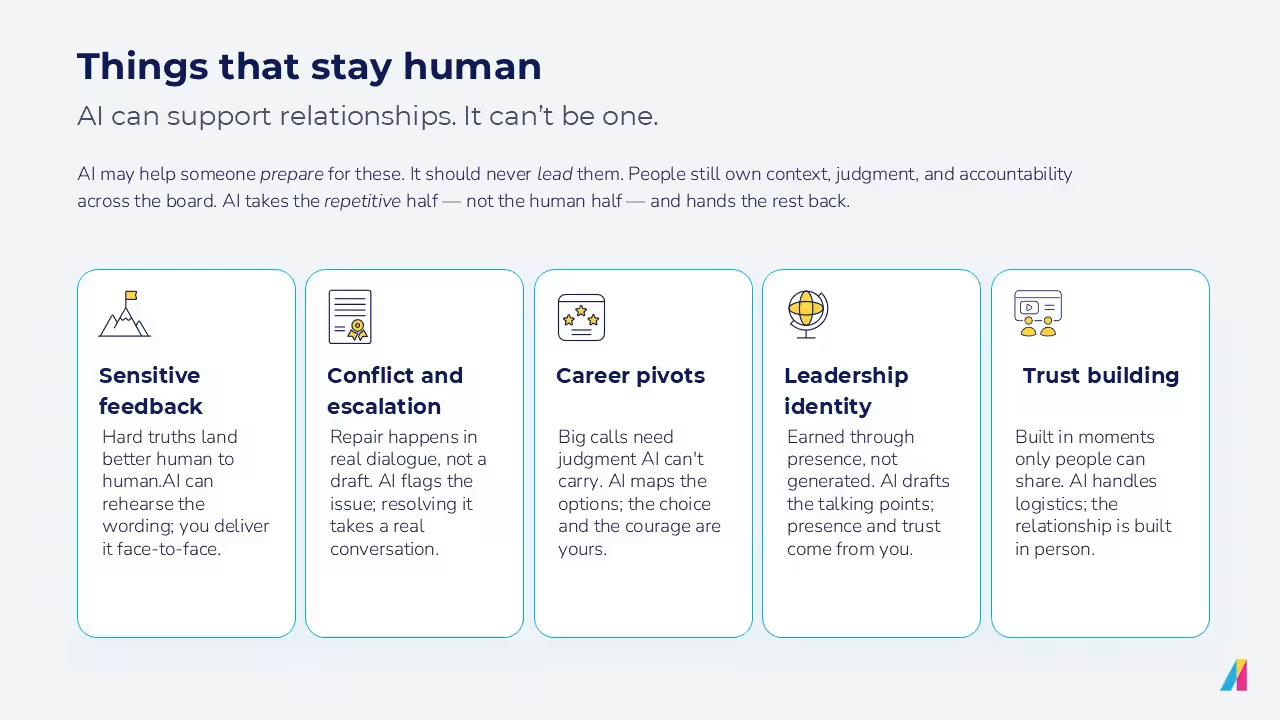
- Keep human. Sensitive feedback. Conflict and escalation. Career pivots and executive transitions. Leadership identity. High-stakes performance calls. Trust-building. AI may help someone prepare for these. It should never lead them.
You might have heard a lazy version of this argument, which gets everything backwards: humans don't just handle "the feelings" while AI handles "the work." People still own context, judgment, and accountability across the board. AI takes the repetitive half — not the human half — and hands the rest back.
Where AI coaching extends human coaching
The best framing: AI is what keeps coaching going when the manager isn't in the room.
Most of a development journey happens in the gaps between conversations and the gaps are exactly where traditional coaching goes silent. That silence is the opening.
Preparation, before the conversation
Before a 1:1, AI can help an employee like Boris surface reflections, weigh options, or draft the questions worth raising. Before a hard conversation, Boris asks Maya to run a private rehearsal and pressure-test the language. The conversation stays human and the warm-up scales.
Reinforcement, after the conversation
Maya gives Boris feedback on Tuesday. Left alone, it's gone by Wednesday. AI keeps it alive — a reminder on Thursday, a quick rep before next week's call, a resource surfaced the moment the skill is needed. This is where most coaching investment normally evaporates, and it's the single most valuable thing AI-powered coaching does.
Practice, in a room where mistakes are free
Simulations, sales objection drills, leadership scenarios, performance-conversation rehearsals — repeated as many times as someone needs, privately, before the live moment instead of during it. Think of the rep who walks into a renewal call having never said the words out loud, learning the script live on a deal that matters. This is how the use case pays for itself.
Now the part everything has been earning its way toward.
A responsibility matrix for AI and human coaching
The model assigns each coaching activity across four players — manager or human coach, AI coaching support, L&D, and the employee — so the work is divided on purpose instead of by whoever's least underwater. To keep it readable, here it is in two halves. First, the part that matters most: who leads, and how AI supports.
Coaching activity | Who leads it (manager / human coach) | How AI supports |
Goal setting | Leads the conversation; aligns goals to role and context | Prompts the employee to reflect beforehand; suggests follow-up questions |
Career conversations | Leads with judgment, context, and relationship | Helps the employee prepare reflections and options |
Difficult feedback | Owns it entirely; handles the emotional nuance | Helps the manager rehearse the language first |
Skill practice | Supports and observes the real application | Leads the repetition, role-play, and simulation |
Reinforcement | Contextualizes and encourages | Sends the nudges, refreshers, and well-timed reminders |
Follow-through | Shares ownership with the employee | Prompts check-ins and tracks the next steps |
Learning recommendations | Reviews and adds context | Suggests resources by role, gap, or need |
Sensitive issues | Leads or escalates | Doesn't own it — points to a human |
And the supporting cast, because L&D and the employee aren't spectators:
Coaching activity | What L&D provides | What the employee owns |
Goal setting | The competency framework and goal-setting templates | The goals themselves, and the progress |
Career conversations | Career pathways and development resources | Reflecting, deciding, voicing aspirations |
Difficult feedback | Guidance and clear escalation rules | Showing up, listening, reflecting |
Skill practice | A map from practice to learning resources | Doing the reps and applying them |
Reinforcement | The reinforcement strategy itself | Applying the skill in real work |
Follow-through | Pattern monitoring; adjusting enablement | Continuing the action between check-ins |
Learning recommendations | Curated content and quality control | Choosing and actually using it |
Sensitive issues | Policy and escalation guidance | Escalating appropriately |
A few rows deserve a walk-through, because "AI supports" doesn’t mean much until you can picture it in real life.
Goal setting. Maya leads, because goals need context and mutual agreement — those are conversation outputs, not algorithm outputs. AI's contribution is on either side of the meeting. It nudges the employee to arrive with reflections in hand, then keeps the goal from going dormant until the annual review. L&D supplies the competency framework so goals stay consistent across teams. The employee owns the goal.
Difficult feedback. This is the row that proves the model. Maya owns the conversation completely — the timing, the emotional read, the accountability afterward. AI never enters that room. What it does is let her rehearse privately beforehand, as many times as she needs, so the first time the words leave her mouth isn't to the person receiving them. L&D sets the escalation rules for when feedback tips into territory that needs HR.
Reinforcement. Notice this is the only row where AI leads. That's deliberate because reinforcement is a frequency problem, and frequency is AI's strength. AI sends the timed nudges; Maya adds context; L&D sets the strategy; Boris does the applying. This is the row most organizations leave unstaffed — which is why training budgets disappear into programs that look complete and change nothing.
Sensitive issues. The point of this row is what AI doesn't do. It doesn't coach. At most it recognizes it's out of its depth and points the person toward a human. If a system tries to counsel an employee through a harassment concern, that's not a feature — it's a liability with a chat interface.
Adapt the rows to your own coaching activities, but keep the principle: every activity has an owner, AI's column is always support except where repetition is the whole job, and the sensitive rows route to people. When you're ready to test this for real, the next step is to introduce AI coaching responsibly.
Absorb’s Aura can help extend learning beyond the sessions.
How to keep AI coaching from becoming a crutch
A real concern. What if you add AI, managers exhale, and coaching stops?
Sam Isaacson, founder of Coachtech says, "Organisations that are starting to get a lot out of AI in coaching aren't actually the ones with the most up-to-date technology, even though they might be the heaviest users of it. The organisations that do it best are the ones who have the clearest vision about what coaching is trying to achieve - and have the patience to see it through."
Underneath all the polite questions about governance sits a common worry. What if you introduce AI coaching, managers feel the relief, and within a quarter the tool has become a substitute for coaching rather than support for it. That risk is real — and it's not hypothetical. When knowledge workers trust an AI tool more, they put less of their own thinking into the task; the tool lowers the felt effort of the work, and the human does less of it.
Coaching runs on exactly that mechanism. Hand the prep to a tool and the manager stops rehearsing the conversation themselves. Let it send the nudges and the manager stops watching whether anything changed. Each step feels like help. Together they add up to a manager who's left the room. But that quiet exit can be prevented with guardrails.
- Decide what AI should never own. Write it down before launch, not after an incident: sensitive issues, employee relations, conflict, high-stakes judgment, and performance decisions are not AI's to own.
- Build escalation into the model. The system needs to know when to stop coaching and start routing. If someone keeps using AI to prepare for the same conflict and the conflict isn't improving, serving more prompts forever is the wrong move — it should point them toward a manager or a human support channel. Keep it practical, not legalistic. Just a note with a clear "this needs a person" beats a paragraph of policy.
- Keep managers on the hook for the relationship. AI can carry preparation and reinforcement. It cannot carry accountability. Managers still own trust, the quality of the conversation, and the relationship — and that ownership should be explicit, so AI reads as leverage rather than permission to disappear.
.avif)
AI isn't replacing the coach. It's keeping coaching continuous between the moments a single human can't be everywhere at once. Good AI coaching software is judged as much by what it refuses to do as by what it automates.
The best coaching system is designed, not chosen
It’s not an "AI vs human" cage match. The strongest enterprise coaching models don't ask AI to replace human coaching, and they don't leave the division of labor to chance. They intentionally decide which moments need human judgment, which need scalable support, and how the manager, AI, L&D, and the employee each carry a piece. Human judgment leads. AI reinforces. L&D enables. The employee owns their development.
Designing the model is your strategy. And proving it works in your organization, without creating another tool people try once and abandon, is your next move.