
Enterprise AI coaching is an embedded development layer that continuously uses context, signals, and interventions to support an employee's capability growth over time. For teams where coaching is already a priority, the problem is scale; for teams still making the case, AI coaching can help do both.
Somewhere in your company there's a manager — let's borrow one and call her Maya. Maya’s got ten reports, two leadership programs to reinforce, a stack of development plans, and a calendar that answered "no" weeks ago. Maya’s a big believer in coaching to elevate her team and the business. She's also unable (by sheer mathematics) to deliver continuous, personalized, well-timed coaching to ten people forever, in the white space between everything else she owns.
That's not a Maya problem. It's math, and almost every manager out there is doing the same impossible sum. In fact, managers account for an estimated 70% of the variance in team engagement.
This is the core problem AI coaching solves. Organizations expect continuous, personalized coaching, but rely on individual managers and one-time training to deliver it. AI coaching exists to close that gap — and the rest of this piece is the (mostly unglamorous) part about how the systems work, where they shine, where they shouldn't go anywhere near, and the big questions to ask before a vendor demo hypnotizes you.
What’s AI coaching? (and how enterprise AI coaching works)
It's a development layer, not a chatbot with a better haircut.
At its simplest, AI coaching is software that helps employees develop skills over time — not by delivering content, but by prompting practice, reinforcing behaviors, and guiding decisions in real work moments.
Unlike traditional learning systems, it doesn’t stop at completion. It stays active across the period where behavior actually changes. The fastest way to misjudge AI coaching is to file it next to the AI tools you already know like the assistant that answers questions or the LMS rule that fires a reminder. It's really neither.
A working definition of AI coaching
Short answer: Enterprise AI coaching delivers ongoing, in-the-flow coaching through prompts, practice, and reinforcement.
Working definition: Enterprise AI coaching is an embedded development layer that continuously uses context, signals, and interventions to support an employee's capability growth over time. It doesn't wait to be asked a question. It pays attention to where someone is in their development, surfaces the right support at the right moment, keeps a skill alive between formal touchpoints, and adjusts as the person improves. The unit of value is never ever the answer to a question, but a behavior that changes.
Four traits that separate AI coaching from its lookalikes
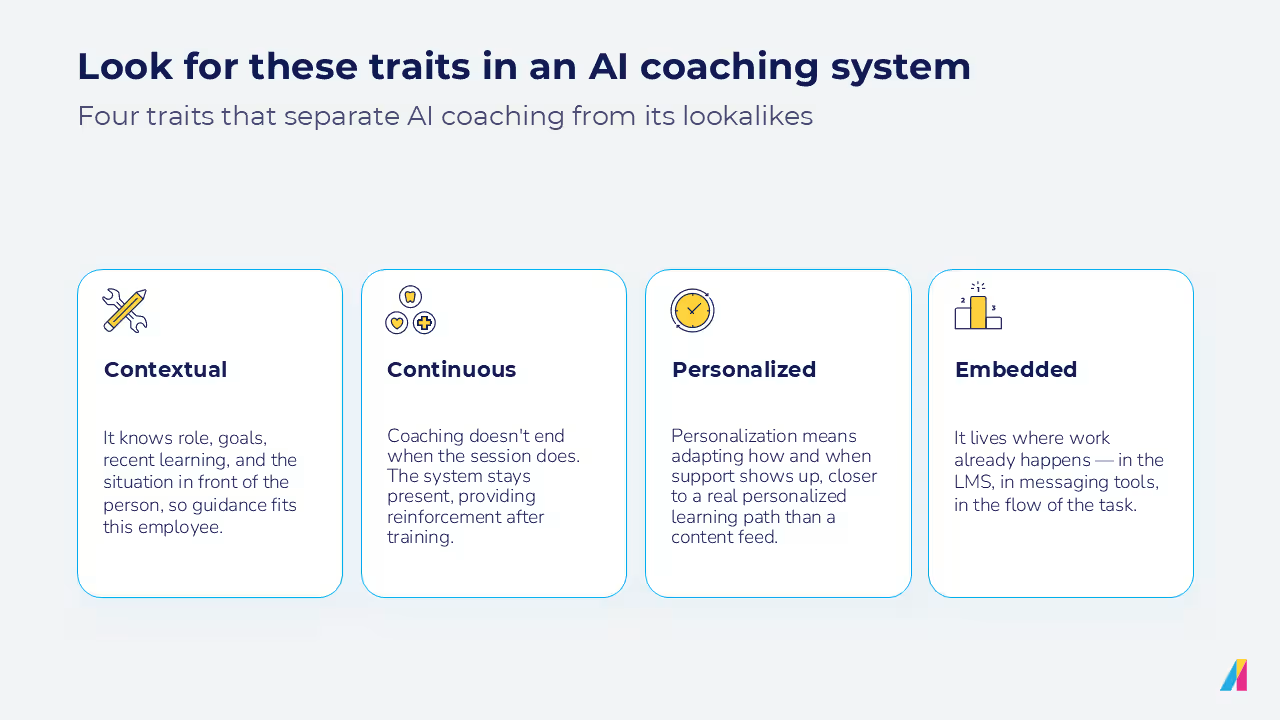
Contextual. It knows role, goals, recent learning, and the situation in front of the person, so guidance fits this employee instead of being advice that could belong to anyone with a pulse and a login.
Continuous. Coaching doesn't end when the session does. The system stays present across the weeks afterward — the stretch where traditional coaching gets buried under other tasks and good intentions expire.
Personalized. Not "here's your next course." Personalization here means adapting how and when support shows up, closer to a real personalized learning path than a content feed.
Embedded. It lives where work already happens — in the LMS, in messaging tools, in the flow of the task — instead of being one more destination nobody remembers to visit.
Put those four together and the lookalikes fall away:
How it behaves | A generic AI assistant or LMS automation | Enterprise AI coaching |
What triggers it | You ask, or a rule fires | Signals, context, and where the person is in their development |
What it remembers | Little — the query, the record | The arc of someone's growth over time |
What it produces | An answer, a reminder, a report | Coaching, practice, reinforcement, well-timed guidance |
What it's for | Resolve the task | Build capability |
How long it sticks around | Until the course is marked done | Across the weeks behavior actually changes |
How enterprise AI coaching turns signals into development
One repeatable loop, no magic required.
Strip away the marketing and most enterprise AI coaching runs the same loop, from signals to interpretation to intervention to adaptation. And the adaption (usually, in the case of individual employees, a behavior change) loops back to provide a new signal, starting the loop again.
Signals
It starts with inputs it can legitimately see like learning activity, skills data, stated goals, engagement, feedback given and received, manager input, practice results, role context. None of it exotic, and most of it already exists somewhere in your stack, probably scattered across an LMS here, a CRM there, a ticketing tool nobody talks to. The job isn't collecting new data; it's reading what you already have together, instead of leaving it stranded in silos that never compare notes.
Interpretation
This is the part everyone imagines as mysterious and is mostly just prioritization. The system looks across the signals and asks a plain question: given where this person is, what would help next? It isn't making talent decisions or grading anyone — it's spotting where a coaching moment is likely useful.
Intervention
Interpretation only matters if it produces something. This is the visible output: a timely nudge, a reflection prompt before a 1:1, a role-play to rehearse a hard conversation, a micro-lesson tied to a real moment of need. The defining feature is timing — support arrives when the behavior is supposed to happen, not three weeks later buried in a report.
Adaptation
Then the loop closes. Based on what the person used and how it went, the system adjusts its next move. It gets more relevant as it learns what works for each person - not magic, but meaningfully smarter over time.
Here's the whole loop, walked through with someone from Maya's team — Boris, a rep who finished his objection-handling training and then, as people do, didn't change a thing. And Boris isn’t a bad guy, but he is human. And only about 12% of learners apply new skills without follow-up after training.
Stage | What the system does | What it looks like |
Signals | Reads the training he completed, his role, and what's showing up (or not) in his work | Module done last week; the new behavior hasn't appeared on a single call |
Interpretation | Decides what support is overdue | "Finished the training, not using it — reinforcement, not more content" |
Intervention | Delivers the coaching in the flow of work | A two-minute role-play the morning before his next pitch |
Adaptation | Adjusts to how he engages | He does the reps and skips the readings, so it sends more reps and fewer articles |
AI coaching benefits: Where it’s gold and where it’s not
It's brilliant at frequency. It's the wrong tool for the moments people remember for years.
AI coaching is not equally useful everywhere. It shines in coaching that is repeatable, reinforcement-heavy, practice-based, or moment-of-need. It's the wrong instrument for anything that turns on trust, ambiguity, emotion, and judgment. Here's where that plays out across the most common enterprise coaching situations:
Coaching situation | How AI coaching helps | What stays human |
Manager enablement | Prep for conversations, feedback practice, reinforcement of new habits, guidance at the moment of need | The conversation itself, the trust, the accountability |
Leadership development | Reinforces behaviors and supports reflection and practice between formal programs | Identity, ambition, and the judgment calls leaders are paid for |
Sales coaching | Role-play, objection handling, script practice, reinforcement after training — real AI sales coaching, measured in reps | Deal strategy, live reads, and motivation |
Onboarding and role transitions | Contextual answers, process guidance, early-confidence reps for AI coaching for teams finding their feet | Relationship, culture, and context only people carry |
Compliance and regulated work | Can support consistent, trackable reinforcement in regulated environments* *Compliance use requires confirmation of platform capabilities | Interpretation and final accountability |
Keep this human. Sensitive employee-relations issues. High-stakes performance decisions. Career pivots and executive transitions. A tool that claims to handle a layoff conversation isn't advanced — it's overreaching, and so is whoever's selling it.
If you're picking a place to start, the safe high-value bet is a frequent, lower-stakes moment in time — manager feedback prep, sales rehearsal — not the most emotionally loaded conversation in the building. To see where this collides with the manager bottleneck specifically, see why managers can't coach at scale and how to split the work in AI coaching vs human coaching.
What makes enterprise AI coaching different
Any tool can create a motivational prompt
Plenty of tools can produce a practice prompt or a motivational paragraph, but that shouldn’t be the bar. Enterprise value comes from a handful of capabilities that have nothing to do with how fancy the interface looks.
It understands your context
Generic advice is the tell of a generic tool. Enterprise-grade AI coaching software reflects your playbooks, policies, approved content, and role expectations — so guidance matches how your organization works, not the average of the internet.
It works where people already work
If coaching lives in a separate portal, adoption dies at the moment of need. Serious systems meet people inside the LMS, messaging tools, and the browser, so support shows up in context instead of requiring a detour nobody takes.
It's governed and trustworthy
Trust is an architectural decision. This is where enterprise and consumer AI part ways for good: data security, configurable guardrails, admin oversight, traceable sources, and clear human boundaries on what AI should never own.
It connects coaching to outcomes
The weakest measure of AI coaching is logins; the strongest is whether behavior and capability moved. Did ramp time drop? Did the new behavior show up on the call? Did the rep close? Good AI coaching platforms shift the conversation from usage to reinforcement, behavior change, and development progress — all of it ideally tied back to the outcomes your business already tracks, like attrition, time-to-productivity, and retention.
The enterprise must-have | The question underneath it |
Organizational context | Does it know how we work, or just how the internet works? |
Workflow integration | Will it show up at the moment of need, or wait in a portal? |
Governance and trust | Can we see, control, and trust what it does and where answers come from? |
Learning-system connection | Does it extend our programs, or bolt on beside them? |
Outcome measurement | Can it prove behavior changed, not just that people logged in? |
How to evaluate AI coaching before the demo dazzles you
Better questions beat a better demo every time.
Before you need a procurement spreadsheet, write down the questions that separate "cool AI feature" from "works inside our learning environment." Five do most of the work, and they'll keep you from being charmed by AI coaching solutions that look pretty on paper but don’t deliver what you need.
Ask this before you buy | Why it matters | What a good answer sounds like |
What coaching gap are we solving? | A vague goal makes a vague pilot that proves nothing | A named moment — "new managers prepping for feedback" — not "AI coaching for everyone" |
Where should the coaching happen? | Placement drives adoption more than features do | In the LMS, messaging tools, or workflow where the need actually shows up |
What data should inform it? | Context quality decides guidance quality | It draws on learning activity, role, goals, skills, and our approved content |
What stays human? | This is the trust question; no clear answer is a red flag | Sensitive feedback, employee relations, and career pivots are explicitly out of scope |
How will we know it's working? | Usage is the easiest and least meaningful number | Repeat use, reinforcement, behavior change, manager confidence — not logins |
AI coaching works best when it's wired into your work
Enterprise AI coaching isn't a replacement for human coaching, and it isn't valuable in the abstract. It earns its place when it's connected to a real coaching need, the workflow where that need shows up, and the way your organization actually operates. Used that way, it covers exactly the moments organizations struggle to scale by hand — practice, reinforcement, preparation, in-the-moment guidance — and leaves judgment, trust, and the hard conversations where they belong.
That's the category. But there's still a question about what happens to Maya, who's still expected to deliver all of this herself. That's where we go next.