
Managers can’t coach at scale because modern coaching expectations, including reinforcement, personalization, follow-through, and continuous development, require more time and consistency than any individual manager can realistically deliver alone.
The biggest issue with coaching at scale is that organizations expect managers to deliver continuous, personalized employee development, but the operating model still relies on individual calendars to carry it. And that’s why AI coaching for managers is utilized in top-performing organizations.
The coaching at scale problem
Somewhere in your company, a manager is about to have a great coaching conversation. Clear feedback, real agreement, both people leaving the room energized. It'll be beautiful. And within about 24 hours, most of it will be gone. Don't shake your head at the manager. She did nothing wrong. It's just that nobody scheduled the part where it sticks.
Now multiply that by every manager, every report, and every program you funded this year. It’s a growing problem in enterprise development, and it’s the gap AI coaching for managers is built to close.
Meet Maya, an experienced manager who is perpetually juggling more than her calendar can hold.
Monday, 8:47 a.m. Nobody added up this coaching load.
One manager, ten reports, and more coaching-at-scale expectations than any calendar holds.
Maya manages ten people. (This sounds like a number and is actually a lifestyle.)
This quarter she's expected to run regular 1:1s, reinforce two leadership programs, shepherd three people through stretch goals, handle one performance issue everyone keeps calling "a conversation we should have," personalize development for all ten, follow up on last month's feedback, and — in the white space between all of it — do the job she was hired for.
Her calendar's a Tetris board where the lines never clear and a new block drops every time someone types "quick sync?"
Now. It's worth saying early that Maya's good at this. Everything that goes wrong this week might seem like a Maya problem... and none of it is. She funded none of these programs and was handed all of them. Each expectation sounded perfectly reasonable in the meeting where it was decided. But nobody added up the column.
(Let's watch the column.)
Tuesday, 2:00 p.m. The coaching moment with a 24 hour shelf life
The conversation goes as the program designed, which is a trap.
Maya has a genuinely great coaching conversation with a rep named Boris. The feedback is specific, he agrees, they build a plan, and they both leave energized — which, in a busy workplace, is roughly the emotional half-life of a sugar high.
It's a real coaching moment. The kind the leadership program was designed to produce. If you measured Tuesday at 2:45, you'd conclude the system works. (And swap Boris for a shift supervisor, a CS lead onboarding her third hire, a nurse preceptor — the mechanics don't change one bit.)
Then Wednesday happens...
Wednesday — the day that eats Tuesday
Reinforcement breaks first because nothing in the workday prompts the new behavior.
Nothing in Boris's Wednesday asks him to use what he agreed to do yesterday. No prompt, no practice, no nudge, no structure. It’s just a normal day with its own agenda, which does not include "remember Tuesday."
This is what we’ll call the Coaching half-life: an insight decays the moment it stops being reinforced. And the only person positioned to reinforce it — Maya — spent Wednesday in back-to-back meetings, one of which could have been an email, and three of which were about a fourth meeting that’ll likely be postponed.
A great conversation with no follow-up is like it didn’t happen. By the next sprint, Tuesday’s gone. The unsettling part is that Maya doesn't know it's gone, because she's already in Thursday-land.
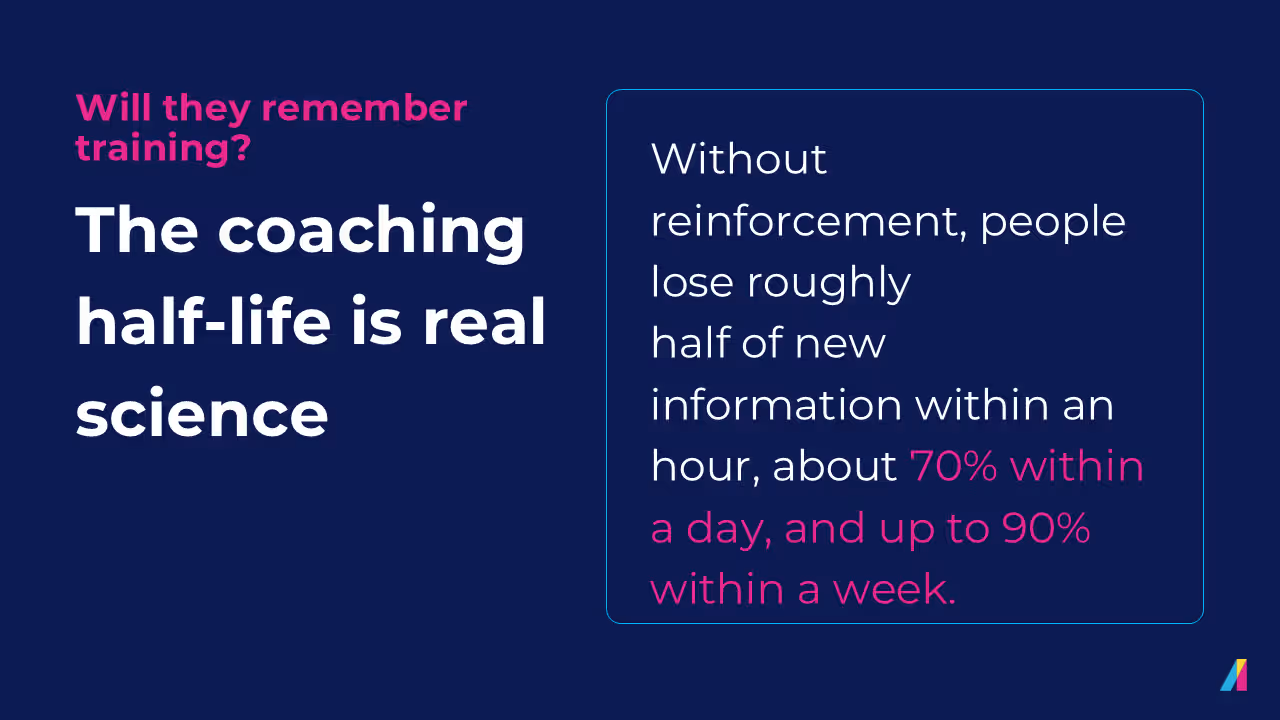
The Coaching Half-Life is real science. The forgetting curve, first documented by Ebbinghaus and repeatedly reaffirmed, shows that without reinforcement people lose roughly half of new information within an hour, about 70% within a day, and up to 90% within a week.
Thursday — development by org-chart lottery
Personalization collapses into generic advice when ten growth plans meet two free hours.
Thursday is development-planning day, which means Maya opens ten growth plans and has the time to meaningfully touch about two of them. The result is that eight people get the corporate house special. "Work on your executive presence." This is the development equivalent of "have you tried turning it off and on again?" It's not that Maya doesn't know what each person actually needs. It's that personalizing ten paths takes hours she has already spent being interrupted.
Meanwhile, across the org, another manager is just as buried. Which means whether an employee gets real, tuned-in development this quarter is decided less by talent or budget than by the org-chart lottery — which manager you happened to get, and how underwater they happen to be this month. Same program. Same company. Wildly different experiences.
The manager is the variable — which is exactly the org-chart lottery, proven by what just happened to engagement. Gallup's latest State of the Global Workplace (2025) found that global engagement fell for a second straight year, and the entire drop traces to managers: between 2022 and 2025 manager engagement dropped nine points, from 31% to 22%, while individual-contributor engagement stayed essentially flat (around 18–19%).
The people we've made responsible for reinforcement are the same people quietly running out of road.
Friday — the call nobody rehearsed
With no safe place to practice, the first rep is the real one.
Friday, one of Maya's reps walks into a high-stakes renewal call. It's the hardest conversation of his quarter, and the first time he's ever said any of these words out loud is to the customer. No time to practice, so the live call is the rehearsal.
Most people get exactly one shot at the moment that matters — the tough feedback, the exec update, the renewal — and the first rep is the real one. There's no safe room to practice in, because the only person who could run that drill is Maya, and Maya is in Friday's version of Wednesday.
Oh, and that development plan she wrote in January? It next gets opened at the annual review, eleven months later. By then, it reads as a list of very good intentions instead of a record of progress.
Coaching that isn't reinforced disappears.
The exact issue Maya and Boris solved so well on that Tuesday way-back-when resurfaces — same behavior, same gap — as if the conversation never happened. Because, functionally, it didn't. It happened, and then nothing happened, which is the same thing.
The coaching failure cascade
Coaching function | What breaks (and where you see it) | Business result |
Reinforcement | Decays with no follow-up — a great Tuesday with Boris, then nothing in Wednesday prompts the new behavior | The same gap resurfaces three months later |
Personalization | Defaults to generic — 8 of 10 plans get "work on executive presence" | Development decided by org-chart lottery |
Consistency | Manager-dependent — two equally buried managers coach the same skill differently | Same program, unequal outcomes |
Practice | No safe rehearsal — the first time the words are said is on the live renewal call | High-stakes moments go unrehearsed |
Maya is underwater, and so is almost every manager. Gallup's data shows only about 30% of managers are actively engaged, and managers report higher stress, anger, sadness, and loneliness than the people they manage, with global disengagement carrying a $438 billion productivity cost. This validates the entire premise — the coaching engine is a person who's running on empty.
None of this is a manager-Maya problem. It's a math problem.
Here’s what coaching at scale looks like: A single manager supporting 8–10 employees can spend 15+ hours per month on coaching-related work alone — before accounting for performance management, hiring, or operational responsibilities. No wonder managers are burning out.
Coaching responsibility | Rough time per report / month | × 8 reports |
The 1:1 conversation itself | 45 min | ~6 hrs |
Prep and notes | 20 min | ~2.5 hrs |
Follow-up and reinforcement | 30 min | ~4 hrs |
Personalized development thinking | 20 min | ~2.5 hrs |
Coaching subtotal |
| ~15 hrs/month |
That's roughly two full working days a month on coaching — before a single escalation, status meeting, hiring loop, or actual deliverable enters the picture. The table is illustrative, not a calculator, but every L&D leader reading it already knows which row their managers are skipping and why manager enablement programs keep stalling right at that row.
(It's the reinforcement row. It's always the reinforcement row.)
It's also the row that decides whether any of the training spend converts. We built a system where the visible half of coaching gets measured and funded, and the half that changes behavior gets handed to an already-full inbox and never mentioned again:
| Training | Reinforcement |
Nature | An event | A process |
Ownership | Centralized | Routed onto the manager |
Visibility | High — you can see attendance | Low — nobody sees it not happening |
Funded | Usually | Almost never |
We didn't design a bad coaching system. We accidentally designed an impossible one — and that impossibility, not a lack of manager effort, is the gap AI coaching for teams is built to fill.
What AI coaching changes (and what it doesn't)
AI coaching doesn't help because the technology is clever. It helps because Maya's whole week is a failure of frequency and consistency — and frequency and consistency are what a human calendar can't supply and an AI-powered coaching system can.
Maya can reinforce a behavior once. AI can reinforce it ten times across a month without anyone scheduling another meeting. That's the clearest case for AI coaching in enterprise, and it's only the start.
It extends coverage, not replaces people. The 1:1s are still the 1:1s. Those require listening skills, empathy, curiosity, and judgement calls. But the four weeks after those meetings no longer have to be silent. AI coaching for managers keeps a baseline of reinforcement and practice running for every employee — including the ones whose manager is underwater this quarter — so development stops depending on org-chart luck.
It makes reinforcement continuous. This is where the coaching half-life problem gets solved. After Tuesday's conversation, the system triggers timely nudges and micro-coaching in the flow of Boris's Wednesday — right when the behavior is supposed to show up. Reinforcement stops being the skipped row because it stops requiring a human to remember.
It changes the rehearsal economics. Role-play, simulations, and difficult-conversation prep happen on demand, privately, as many times as someone needs — before the renewal call, not during it. That's real AI coach employee development, not content recommendations, but reps.
What stays human
For anyone thinking that AI might replace the work of managers, they’re just forgetting that managers manage humans. (Don’t forget that part.)
Stays human | AI supports |
Career direction and high-stakes decisions | Reinforcement and well-timed reminders |
Sensitive or emotional feedback | Practice and rehearsal (role-play, simulations) |
Judgment, context, and nuance | Preparation for the hard conversation |
Read it left to right and the replacement anxiety drains out. AI isn't moving into the left column. It's finally staffing the right one — the work that was theoretically Maya's and practically nobody's. Good AI coaching software is judged not only by what it automates, but by what it deliberately leaves alone. (Where exactly to draw that line is its own conversation — designing AI and human coaching together.)
What Maya's week looks like with the system carrying the load
Pull the high-frequency work off one calendar and the operating model upgrades.
Let's run the same week back — same Maya, same Boris, same Tuesday conversation — with the system carrying the parts a calendar can't.
Wednesday, Boris gets a short prompt tied to exactly what he and Maya agreed to: one small rep, in the flow of the work he was already doing. Thursday, instead of the house special, his development path is personalized against the gap his actual conversation surfaced. Before Friday's renewal, he runs the call twice in a private simulation — so the live one is the third rep, not the first. And Maya can see all of it happened: the nudge landed, the practice ran, the plan moved. None of it required her to remember a thing.
Maya doesn't disappear from development. She gets leverage. The hours that were eating her time without using her judgment (remembering every follow-up, scheduling every practice rep, manually reinforcing every program) get handled by the system. What's left is the work only she can do. She reads context, builds trust, lifts her people up, and makes the call. She stops being the bottleneck and becomes a critical part of the system, the one who reads context, builds trust, and makes the call.
Development also becomes visible. In the manager-only model you can't see reinforcement failing until a number slips. When coaching runs through an AI-powered system, the activity leaves signals — practice happened or it didn't, reinforcement landed or it lapsed — so L&D can finally see development occurring between programs and improve it, instead of inferring it from lagging outcomes.
And the most durable version of this is that coaching that shows up where work already happens — in messaging tools, inside personalized learning paths, in the LMS context, at the moment of need. (This is also where a platform like Absorb Aura fits — connecting AI coaching support to the learning and workflow-based learning support moments where it sticks.)
Old model | Emerging model | What changes |
Manager-led | AI-supported ecosystem | Coaching no longer rides on one calendar |
Session-based | Continuous | Reinforcement lives between the meetings |
One-size advice | Personalized | Development adapts to the individual |
Scheduled | Embedded | Coaching appears inside the workflow |
Manual | Adaptive | The system remembers, so the manager doesn't have to |
AI doing the carrying, managers doing the judging is what moves coaching as a heroic individual effort to AI coaching at scale as infrastructure.
The question was never whether managers should coach more
It’s really impossible to ask one person to singlehandedly deliver continuous, personalized, reinforced coaching to every report, forever, between everything else they own.
Coaching at scale was never going to come from asking Maya to try harder inside a full calendar. It comes from AI extending the coverage, consistency, and reinforcement she can't supply alone. AI coaching is a solution that matches the scale of the problem organizations already have.
And all that makes the next question important. What parts of coaching should stay human, and where exactly should AI lead?
That's what we take apart next: AI coaching vs human coaching: How enterprise teams design both together.