
A customer education business case earns budget when it answers the specific objection each stakeholder raises. Most champions never get there because the room stops listening. But customer education works and an excellent program shortens onboarding, lifts adoption, and protects renewals.
So why do so many pitches stall before the math even starts? Half of customer education programs call themselves mature, but only 19% have the infrastructure to prove it — a dedicated budget, a formal executive sponsor, current content, and proactive lifecycle engagement. A skeptical room can sense the gap between confidence and proof. But proof is what everyone needs since 97% of organizations are now experimenting with or actively running customer education programs.
That proof is fair for the room to ask about. The chief financial officer (CFO) wants a number, not a feeling. The Sales VP hears “training” and thinks “cost center.” The customer service (CS) leader has watched three platform pitches die in committee this year alone, and she’s tired. So how do you prove the business case to a group of professionals whose entire job is finding the holes in your argument?
Building a business case for customer education: Using a skeptic’s seat framework
To prove your case, there are five strong, meaningful metrics, tying customer education to business goals. And to make sure we dig into what stakeholders need, let’s call it the skeptic’s seat framework. The skeptic’s seat framework is simple. Before you write a single slide, occupy each stakeholder’s chair and ask what they’d say no to. Then build your formula, your framing, or your data point as the direct answer to that voice. This article walks through concerns and responses stakeholder by stakeholder, ultimately answering what matters to each and how to prove it matters to the business.
If you only have a minute, there is a bottom line to keep in mind. Building a defensible business case separates activity metrics from executive metrics, picks two or three ROI levers it can definitively prove, shows its math with visible assumptions, and tailors its framing to whoever's in the room — CFO, Sales VP, or CS leader. Everything below is the longer version of that sentence.
What a customer education business case needs to prove
Start here: before ROI formulas or slide frameworks, the first thing to get right is what the business case needs to prove and also what it should leave off.
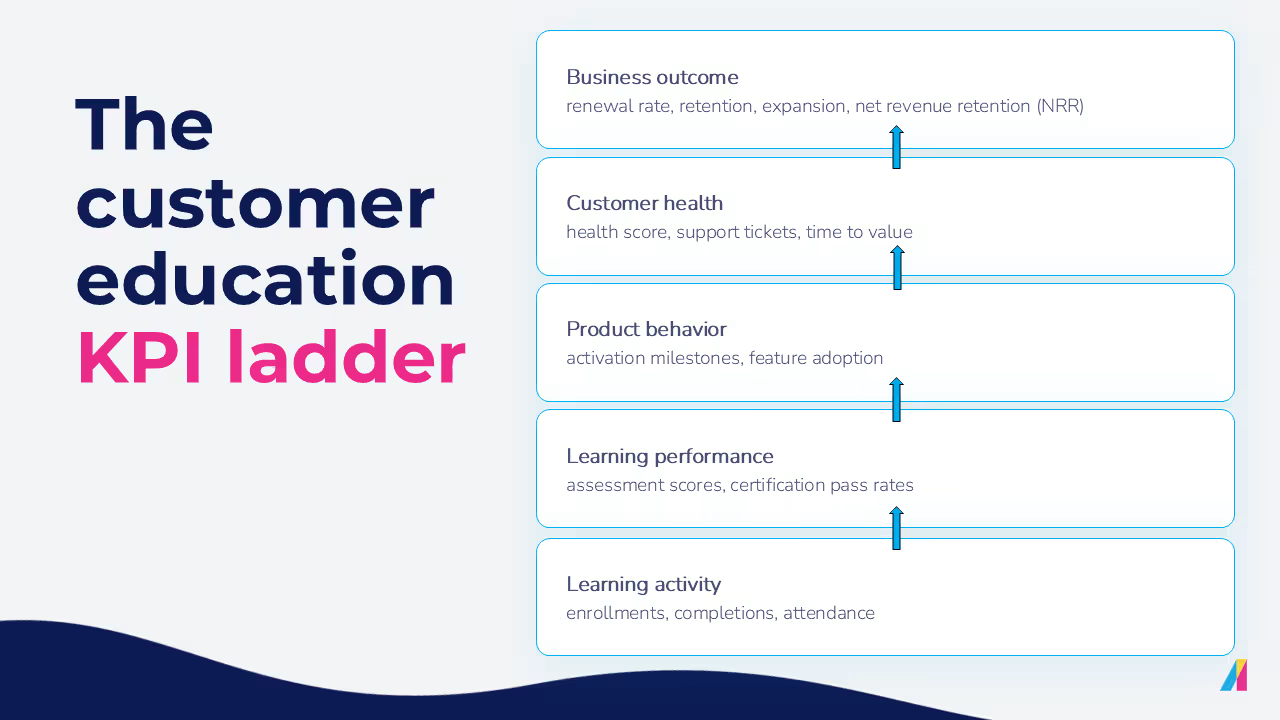
A business case is a claim, not a catalog. It argues that customer education changes outcomes the business already tracks — support cost, CSM hours, renewal rate, time-to-value. It’s not a tour of the courses you've built.
"When you're making the business case for customer education, don't sell it as education. Sell it as an efficiency driver and a revenue protection layer. If customers don't adopt, nothing else matters — and product alone doesn't solve for scale, complexity, or change management. Customer education fills that gap."—Darren O'Connor, Director, Customer Success
The objection: “This sounds like a content project, not a business priority.”
You'll hear this first, and it's a fair hit. Most customer education pitches lead with the beehive of activity — courses published, videos shipped, learners enrolled — because that data is sitting right there in the LMS dashboard, one export away. But activity can’t be the argument. The argument is what that activity changes downstream. How fast do customers reach value? How often do they need a human to rescue them? Do they renew or convert?
The stakes behind those questions are bigger than they look. Of the 97% of organizations using or experimenting with customer education, 30% describe their own programs as underperforming on goals or objectives, and 6% say they can’t measure performance at all. A likely culprit is misaligned investment: 57% of programs name retention as their top objective, yet 42% of investment still concentrates on onboarding regardless of that stated priority — and the pattern barely moves even among programs that specifically name retention as the goal, where onboarding investment sits at 42% versus 41% for programs that don’t. The programs that break this pattern map their content calendar to the lifecycle stages where customers are really churn, not just where they arrive.
The first step? Separate what you did from what changed.
Business outcome | What customer education can influence | Evidence to include |
Time-to-value | Faster onboarding and time to first value | Onboarding completion time, product activation data |
Support ticket volume | Fewer repeat support tickets | Help desk ticket volume, deflection rate |
CSM hours per account | Less repeated 1:1 training | CSM time logs, capacity freed per account |
Retention | Stronger renewal and expansion behavior | Renewal rate, account health score, expansion revenue |
A business case built only on the left column is simply an activity report, and doesn’t prove business impact. The change is the key.
The objection: “How do I know this isn't just correlation?”
You don't, fully. The champions who win the room say this before anyone else asks. Customer education influences time-to-value, support load, adoption, and retention. It rarely causes any of them by itself, and pretending otherwise is the fastest way to lose the room. Instead of fighting a losing battle of questionable assertions, use strong, real contribution language: “can reduce,” “tends to shorten,” “is associated with.” Skeptics extend more trust to people who show their assumptions and can present both sides of an argument.
Overconfidence — not skepticism — is the more common failure mode, so candor matters a lot. 52% of programs say they're very confident they can demonstrate ROI. But among that confident group, 31% still lack the analytics capability to do it, 20% have systems too disconnected to pull the data, and 21% haven't even defined what success looks like. In most rooms, the problem isn't a skeptical CFO. It's a champion who hasn't built the proof yet.
The ROI drivers behind customer education
Once you’ve separated activity from outcomes, the next question is which outcomes are actually worth quantifying — and which ones your finance team will trust. Three financial levers tend to survive scrutiny, and you won't get to choose which one your CFO picks apart first — so know all three cold before you walk in.
“Leadership doesn't really care what people have learned, they care about what the impact is. How did it get me more customers? How did it get me better renewals? How did we get better usage?” —Michele Wiedemer, Research Trustee, CEdMA
The objection from the CFO: “Where, specifically, does this save or make us money?”
Support deflection is usually your strongest lever, because the proof already lives in tools Finance trusts. If customers who finish training open fewer tickets in Zendesk or Salesforce Service Cloud, that's a real cost line. Knowledge-base-driven self-service has cut support ticket volume by 25% or more at companies like Atlassian — the same mechanism customer education runs on.
CSM capacity turns repeated effort into reusable infrastructure. If your CSMs are running the fortieth identical onboarding call this quarter, customer education converts that repetition into content once and reuses it indefinitely. Frame this as freeing strategic time per account, not as a justification for cutting headcount — the moment a CFO hears “fewer people,” the conversation stops being about education and starts being about layoffs. A CSM who spends two fewer hours per onboarding isn't twiddling their thumbs; they're picking up the adoption-risk conversation that used to fall through the cracks.
Faster time-to-value opens implementation capacity and pulls renewal risk earlier in the lifecycle, where it's cheaper to address. It's harder to isolate than the first two levers, so only lean on it if you already have onboarding-stage data in your product analytics tool.
For a deeper look at how to design a system that removes repeatable training from CSM calendars once the budget conversation is won, see our guide to [scaling customer training without burning out CSMs].
Driver | Question it answers | Where the data lives |
Support deflection | Are trained customers calling support less? | Help desk, LMS |
CSM capacity | How many hours go to repeatable training? | CSM time logs, calendar data |
Time-to-value | Are customers reaching value faster? | Product analytics, onboarding records |
Retention and expansion lift belong on your list, but treat them as the lever you build toward, not the one you open with. They take longer to prove and invite the heaviest scrutiny. Earn credibility on the first three before you reach for them.
Customer education ROI formulas and example calculations
Knowing which levers apply is half the work. The other half is turning them into numbers a CFO can audit. Four formulas, each built to survive being read aloud by someone whose job is to find the hole in it.
The objection: “I want math, not fluffy adjectives.”
Support deflection savings
- Reduced support tickets × average cost per ticket = savings
- Example: 150 fewer tickets per quarter × $35 average cost per ticket = $5,250 in quarterly savings.
CSM capacity savings
- Repeated training hours reduced × CSM hourly cost × number of accounts = savings
- Example: 2 hours saved per onboarding × $65 CSM hourly cost × 80 accounts per quarter = $10,400 per quarter.
Time-to-value impact
- Reduction in onboarding time × value of added implementation capacity = impact
- Example: 5 fewer days to first value, freeing capacity to onboard one additional account per CSM per quarter — a capacity gain, not just a faster clock.
Retention contribution
- At-risk revenue influenced × retention lift assumption = contribution
- Example: $400,000 in at-risk renewal revenue × a conservative 5% retention lift assumption = $20,000 in contribution. Say the word “assumption” before anyone in the room makes you say it.
A 5% improvement in retention can lift profit by 25% or more — which is why the room will want to know where your 5% came from. Five percent is deliberately conservative — industry research frequently cites retention improvement in the 5–15% range for well-designed customer education programs, which is why naming your assumption source matters as much as naming the number itself.
A customer education ROI calculator built around these four formulas gives champions a reusable tool for any funding conversation. If you’re looking for a shortcut to building the first draft of your calculation, here’s an idea for a starting prompt:
Starter AI prompt for your ROI case “I’m building a customer education ROI case. Given [average ticket cost], [CSM hourly cost], and [accounts trained], walk me through a conservative support-deflection and CSM-capacity calculation, and flag any assumption that needs a caveat.”
The objection: “These numbers feel made up.”
They will, if you don't show your inputs. Every formula above has three components a skeptic can challenge: the baseline, the assumption, and the source. Name all three before anyone has to ask. A number with a visible assumption can survive in a tough room. A number without one can easily get torn apart.
Which metrics belong in the business case
Formulas prove the math. But before you walk into the room, you also need to know which metrics belong on the slide — and which ones, no matter how easy they are to pull, will undermine the case you just built. Metrics fall into three tiers and conflating them is one of the fastest ways a business case loses the room.
The objection from the CS leader: “Don't give me a vanity number. What's really going to hold up when someone challenges it?”
Metric tier | What it proves | Executive use |
Reach (completions, active learners) | Customers are engaging | Shows the program is running |
Efficiency (CSM hours saved, tickets deflected) | The program saves time and cost | Defensible cost case |
Business impact (renewal rate, account health) | Education connects to outcomes leadership owns | The strongest argument in the room |
Completions prove reach. Reach matters — but only once it's paired with something the CFO or CS leader already tracks, like fewer tickets, faster renewals, healthier accounts. A completion rate answers “did people show up.” It doesn't answer “did anything change.” Connecting training data to CRM and account outcomes in more depth is its own conversation, one we cover fully in our guide to customer education KPIs.
How to present the business case to executives
Sequence matters as much as content. Program data shows progress follows a specific order: measurement capability comes first, then evidence, then executive confidence, then budget, and only then formal sponsorship.
The objection from the Sales VP: “Why is Customer Success spending money instead of closing more deals?”
This one gets ignored a lot. The answer is to point out that renewal and expansion revenue is revenue. Sales never has to re-win from scratch. A trained, confident customer is a smaller flight risk and a likelier expansion conversation. Customer education protects the number Sales is trying to grow. Frame it as a teammate to the sales motion, not competition for the same budget line.
The most common mistake is making the case before the proof exists, so the formulas and metrics above need to be locked in before you build a single slide. Six slides, one for each beat the room needs, and not one more.
The objection from everyone in the room, simultaneously: “Get to the point.”
- Current problem — the cost of doing nothing, in numbers the room already recognizes.
- Business impact — what changes if this works: adoption, support load, retention.
- Customer education opportunity — the specific intervention, like self-paced courses or certifications.
- ROI levers — the two or three drivers you can defend, formulas attached.
- *Investment request — budget, a pilot, or a platform decision, named specifically.
- Metrics and phased rollout — how you'll know it's working, and when you'll report back.
*Slide 5, the investment request, is where sponsorship and budget do the most work — and the data shows why both matter together, not separately. Programs with both a formal executive sponsor a a dedicated budget report 72% strategic positioning and 74% ROI confidence. Programs with neither sit at 25% and 36%. If you're only going to ask the room for one thing beyond money, ask for a named sponsor.
Program profile | Strategic positioning | ROI confidence |
Formal sponsor + dedicated budget | 72% | 74% |
Neither sponsor nor budget | 25% | 36% |
Speak to the skeptic in the room
Stakeholder | Listening for | How to frame it |
CFO | Cost and ROI | Lead with support deflection and capacity savings — cleanest data trail |
CRO or CS leader | Retention, expansion, capacity | Training protects renewal revenue and frees CSM time |
Support leader | Ticket volume | Show the deflection formula with their own ticket cost plugged in |
Product leader | Adoption, feature usage | Tie completion to feature activation, not just course completion |
If you can't defend a slide against the person most likely to push back on it, cut the slide. Don't soften the claim to keep it.
Once the business case lands, decisions about the right learning infrastructure typically follow — our guide to [building a business case for a dedicated customer LMS] covers that next conversation.
Customer education becomes a growth system, not a content program
Once the deck is tight and the framing is right, step back and check whether the core argument still holds. A strong business case never argues that training is helpful — everyone in the room already half-believes that, or you wouldn't be presenting. It shows specifically where customer education reduces a cost someone already tracks, protects revenue someone already owns, and gives a team room to grow without adding headcount.
You won't need to win over the whole room on the first pass, but you will need one number that survives the first hard question. Get that, and the rest of the deck follows it. There's a bigger payoff waiting past that first number, too because 56% of respondents say that thinking more strategically about how learning programs connect to business outcomes would be transformative for their organization's ability to innovate. The business case is only about getting funded. It's also how customer education earns a seat in the strategic conversations.
Once the budget conversation is settled, the next question is how you scale customer training without burning out the CSMs who've been carrying it manually by hand? That's the subject of our next guide, From 1:1 onboarding to 1:many: How to scale customer training without burning out CSMs.